


ACME’s Recent Industry & Community Involvement
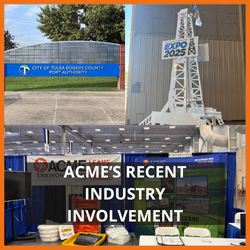
Industry Involvement Recently, ACME Environmental participated in and proudly sponsored several key industry and community networking events, each designed to...
Read MoreFollowing the explosion and subsequent fire at Smitty’s Supply in Roseland on August 22, black, oily runoff containing unknown chemicals has seeped into the Tangipahoa River, raising serious concerns about long-term environmental damage and potential repercussions for Lake Pontchartrain. The contaminants, which emit an odor similar to asphalt, became visible over 40 miles downstream within just a few days of the incident.
The U.S. Environmental Protection Agency (EPA) is leading cleanup efforts, deploying more than 14,000 feet of oil spill containment boom and thousands of absorbent pads. However, local residents and environmental groups argue that these containment boom systems are primarily designed for oil and are failing to contain the hazardous mixture of chemicals, firefighting foam, and oily residue that is leaking into the river. Black, tar-like substances have been spotted washing ashore, coating logs and vegetation along the banks.
Residents living downstream reported noticing a growing petroleum odor, oil sheen, and black sludge in the water within 48 hours of the fire. By August 29, the contamination had been documented as far as 47 miles downstream, just shy of the Joyce Wildlife Management Area. Social media posts suggest that impacts may even be evident near the mouth of the Tangipahoa River. Environmentalists emphasize that the Tangipahoa River, recognized for its scenic beauty, is particularly at risk. The river supports various activities such as fishing, canoeing, and swimming, while its surrounding vegetation plays a crucial role in flood mitigation. Experts warn that chemical contamination could harm these plants, increase the risk of flooding, and infiltrate the food chain through fish, crabs, and shrimp in Lake Pontchartrain. Local residents and advocacy groups are demanding transparency from both Smitty’s and governmental agencies. With hazardous waste still unaccounted for, many are seeking clearer answers regarding which chemicals have entered the river, the extent of their spread, and what long-term measures will be implemented to protect public health and the ecosystem. To learn more about this incident, read this article.
At ACME Environmental, we recognize that not all spills are oil spills; many involve different mixtures of chemicals, residues, and debris that standard boom systems simply can’t handle. That’s why we focus on developing custom-designed containment boom and spill barrier systems specifically tailored to meet these challenges. Whether you need our compact 10″ Boom for creeks and swamps or our Perma-Boom for long-term deployment, ACME has a containment solution to suit all spill scenarios. Learn more about our containment boom solutions in this article.
Here are some benefits of ACME products:
Deeper Skirts: ACME specializes in the custom fabrication of oil spill containment boom and various oil barriers that can be designed with deeper skirts that effectively manage heavy, sinking contaminants and debris. Unlike standard containment booms, which often feature shorter skirts that may struggle to contain such materials, our specially engineered solutions provide enhanced stability and effectiveness in challenging conditions, ensuring that even the most stubborn pollutants are kept at bay.
Heavier, Reinforced Fabrics: ACME’s durable fabrics are specifically engineered to endure extreme conditions. They resist harsh chemical exposure, stand up to abrasive environments, and can handle high-flow waterways with ease. This resilience ensures that the containment systems remain intact and function effectively without the risk of tearing or failure.
Rugged Boom and Oil Spill Barrier Systems: ACME’s oil spill containment boom and oil barrier solutions are engineered for effective deployment in challenging environments where durability and reliability are crucial. These products are specifically designed to withstand harsh conditions, ensuring maximum performance and protection against oil spills in both calm and turbulent waters. With a focus on resilience, ACME’s solutions offer peace of mind for environmental protection and cleanup efforts.
Sorbent Materials: ACME’s line of sorbents enhances a responder’s ability to absorb oils and chemical mixtures quickly, minimizing spread and secondary contamination. ACME provides oil-only and universal sorbents that effectively tackle chemicals and hydrocarbons both on land and in water.
Anchoring Systems: ACME’s complete anchor systems keep containment boom systems in place, maintaining effective positioning even in strong currents or shifting water conditions.
Proper Training: ACME’s Boom School provides comprehensive instruction on boom deployment, anchoring, and maintenance, combining classroom education with real-world, hands-on field training. This program equips crews with the knowledge and confidence to respond effectively under pressure, ensuring booms are deployed quickly, anchored securely, and maintained correctly. By training with ACME’s experts, teams gain practical experience that reduces costly mistakes, improves safety, and strengthens overall spill preparedness.
By combining our engineering expertise with rapid spill response capabilities, ACME Environmental provides the tools and strategies needed to limit downstream impacts, protect sensitive habitats like the Joyce Wildlife Management Area, and reduce long-term damage to rivers, wetlands, and connected ecosystems such as Lake Pontchartrain. When off-the-shelf solutions fall short, we deliver custom containment systems tailored to the unique challenges of each spill.
Beyond equipment, our Boom School training program equips teams with the knowledge and hands-on experience to deploy boom effectively under real-world conditions. This ensures faster, safer, and more reliable spill response when it matters most.
Contact us today to strengthen your spill preparedness with customized solutions and professional training.
Here are some articles that you may find interesting:
Additional Resources
Posted on: October 21, 2025
Industry Involvement Recently, ACME Environmental participated in and proudly sponsored several key industry and community networking events, each designed to...
Read More
Posted on: July 1, 2025
Are You Prepared? Hurricane season has officially begun, and the need for preparation is here, not just for families and...
Read More
Posted on: March 7, 2025
Building Trust and Excellence ACME Environmental is proud to announce 19 years of partnership with ISNetworld, highlighting our dedication to...
Read More
Posted on: July 26, 2024
Introduction ACME Environmental is proud to sponsor the 2024 Spill Control Association of America (SCAA) annual meeting on July 31-August...
Read More