


ACME’s Vacuum Truck Services
What Are Vacuum Truck Services? Some people who need vacuum truck services may never have considered it or may not...
Read MoreACME Environmental’s custom floating baffle systems play an essential role in the operations of water treatment facilities. These innovative systems address numerous challenges that can arise within treatment ponds, water basins, and cooling systems. By strategically managing water flow and enhancing sediment control, water treatment baffle systems help mitigate potential issues, ensuring the efficiency and effectiveness of treatment processes. This approach not only prevents complications from developing later but also contributes to more reliable and sustainable water management solutions.

Diagram showing short-circuiting of water in water treatment
This occurs when water flows continuously through a system without any incorporated systems in place for retention, leading to the formation of what is known as dead space. In these stagnant areas, sediment gradually accumulates, resulting in thick layers of silt often referred to as “false bottoms.” These false bottoms create significant challenges as they disrupt the natural balance of water flow within the system. This imbalance can lead to the development of more false bottoms, which further complicates the treatment process and makes cleanup efforts more difficult and costly. The buildup of sediment not only slows water movement but also creates an environment where additional problems can arise, worsening the overall maintenance issues within a water treatment system.
The impact can be significant; water quality declines as untreated flow bypasses the system, costly and time-consuming dredging becomes necessary to remove thick sediment, and long-term maintenance expenses rise. ACME’s custom floating baffles address this challenge at the source by extending retention time, promoting thorough mixing, and ensuring even sediment distribution. The result is cleaner water, more efficient treatment, and substantial savings in both maintenance and operating costs.
Water treatment facilities are rarely the same, and each comes with its own set of challenges. A system may work effectively today, but factors like population growth, facility expansions, or stricter regulations can quickly change its demands. When this happens, flexibility becomes essential. Without the ability to adapt, facilities risk inefficiencies, compliance issues, and costly redesigns.
This is where ACME makes a difference. Our expertise lies in designing baffles with flow patterns tailored to the specific needs of each site. Whether it’s extending retention time in a settling basin, controlling algae growth in a reservoir, or minimizing dead zones in a cooling pond, ACME tailors solutions that are built for the exact challenge at hand. By fine-tuning flow control, we help facilities maximize treatment efficiency while maintaining compliance with environmental standards.
Equally important is adaptability over time. ACME’s baffles aren’t permanently static systems; they are engineered to grow and change with your operation. They can be relocated to new positions as site conditions evolve, modified to improve performance, or upgraded with flow-through windows that allow for even greater control of water movement. This adaptability ensures that our solutions not only solve today’s problems but also remain effective as challenges evolve in the future.
ACME’s custom baffles are engineered for durability and performance. Built from flexible reinforced PVC-coated fabrics and RF-welded, they form a strong barrier that resists wear, weathering, and environmental stress while remaining easy to handle. For stability, each system uses closed-cell flotation logs, a chain ballast, and tension cables to hold position in changing conditions. Flow-through windows can be added to control water direction, eliminate dead zones, and improve treatment efficiency. Designed to withstand shifting currents and sediment levels, ACME baffles deliver reliable, low-maintenance performance that ensures long-term stability and adaptability.
Baffle & Turbidity Curtain Information Packet

Thumbnail for Wastewater Treatment Baffle
Floating baffles serve an essential role in aquatic environments by improving water quality and reducing pollution. They help regulate algae growth, safeguard sensitive ecosystems, and keep harbors, marinas, and treatment facilities free from sedimentation. Because they are highly adaptable, floating baffles can be used in a wide variety of settings, making them a versatile tool for effective water management in treatment facilities. From protecting sensitive habitats to maintaining the cleanliness and safety of recreational and commercial waterways, they are a critical component in sustaining healthy aquatic systems.
ACME designs its baffles specifically to control water movement within water treatment operations such as cooling ponds, settling basins, and oxidation ponds. In these facilities, the baffles improve sedimentation by directing water through a longer, controlled path, allowing sediment particles more time to settle. This extended retention time reduces particle buildup and delivers cleaner, higher-quality water output. Without this flow control, water often takes a direct path, a problem known as short-circuiting, which shortens treatment time and leaves behind stagnant areas known as dead zones. These dead zones lead to heavy sediment buildup that can eventually create something called a false bottom. Removing these false bottoms is not only labor-intensive but also costly, underscoring the importance of prevention.
Diagram showing short-circuiting of water in water treatment
ACME Environmental’s side-to-side diversion baffle is specifically designed to guide water laterally across treatment areas, greatly improving overall efficiency. By altering the natural flow path, the system increases retention time, which allows for more complete settling and filtration. As the illustration below shows, this setup distributes water evenly throughout the basin, eliminating stagnant zones that often contribute to sediment buildup. This prevents the formation of a false bottom and ensures consistent sediment removal, resulting in cleaner water and smoother treatment processes.
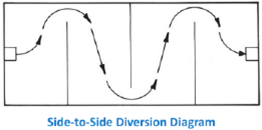
Diagram showing a side-to-side diagram of water in water treatment
For projects requiring adaptability, ACME Environmental offers a flow-through window diversion baffle. This design integrates strategically placed windows within the skirt, allowing water to move through while still being redirected. The flexibility of this system makes it ideal for handling complex or changing flow conditions. The figure-eight configuration shown in the illustration demonstrates how this design enhances circulation, minimizes dead zones, and reduces excess sediment accumulation. This ensures efficient water movement and long-term system performance.

Diagram showing flow through windows in a baffle system
The top-to-bottom mixing baffle is engineered to generate a vertical circulation pattern that promotes full water-column mixing. This approach distributes sediment uniformly, reducing the risk of uneven accumulation or false bottom formation. The inclusion of flow-through windows strengthens the mixing effect, enabling control of water movement throughout the treatment zone. This system not only maintains sedimentation efficiency but also helps sustain overall water quality for optimal treatment outcomes.

Diagram showing a top-to-bottom mixing baffle system in water treatment
Installing and deploying floating baffles is not a one-size-fits-all task—it requires a carefully planned and executed process to ensure they perform at their highest efficiency in maintaining water quality. The process begins with a thorough site assessment, where ACME’s experts evaluate water conditions, flow patterns, and facility-specific goals such as controlling algae growth, preventing dead zones, or managing sedimentation. This step is critical, as proper placement directly determines how effective the baffles will be in optimizing water flow and treatment outcomes.
Once the optimal placement is identified, the baffles are constructed with precision and secured through stainless-steel anchoring systems designed to endure a wide range of water currents, changing conditions, and varying levels of sediment. This durability ensures that the baffles remain stable and reliable over time, even in demanding environments.
Equally important is the anchoring and securing process, which is fundamental to the long-term stability of the baffles. Without proper anchoring, their effectiveness in redirecting flow and preventing short-circuiting could be compromised. To maintain peak performance, regular inspections and maintenance are necessary. This allows for the early detection of wear, sediment buildup, or algae accumulation. Adjustments or replacements can then be made to keep the system operating effectively.
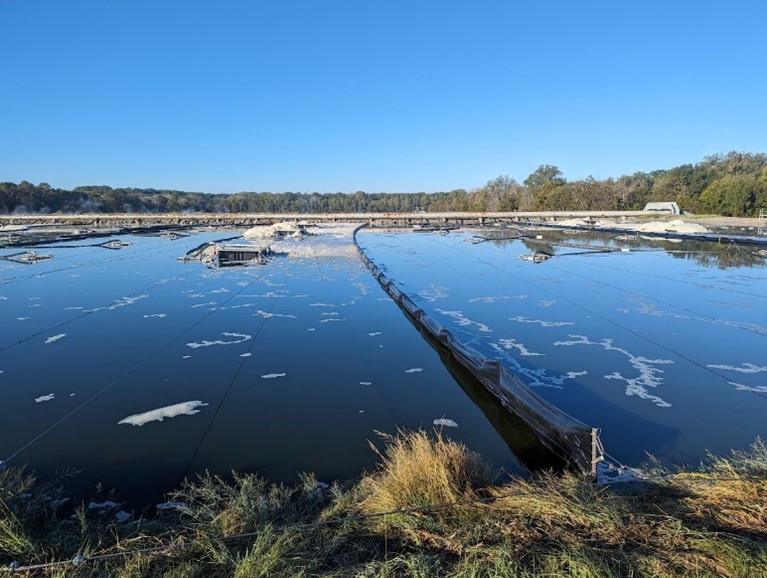
A baffle that had been deployed and installed by ACME employees
Through this process of planning, installation, anchoring, and ongoing maintenance, ACME Environmental ensures that floating baffles consistently deliver maximum efficiency in water quality management, sedimentation control, and algae prevention for water treatment facilities.
Baffle & Turbidity Curtain Deployment Brochure
Floating baffles are not just a component of water management; they are a critical investment in long-term water quality and system efficiency. With ACME Environmental’s expertise in planning, installation, and ongoing maintenance, facilities gain a proven solution that ensures consistent performance, prevents costly issues like sediment buildup and algae overgrowth, and safeguards the health of aquatic environments. Choosing ACME means choosing durability, reliability, and sustainable results for the future.
Contact Us to Receive a Customized Quote


Posted on: September 11, 2026
What Are Vacuum Truck Services? Some people who need vacuum truck services may never have considered it or may not...
Read More
Posted on: September 1, 2026
Now What? When cleanup crews leave the site and the last bit of impacted soil is “removed”, it’s tempting to...
Read More
Posted on: August 3, 2026
The Cost of Waiting Too Long When an oil or chemical spill occurs, every minute counts. What may begin as...
Read More
Posted on: June 19, 2026
Why Preparation Matters When severe weather strikes, industrial facilities face risks that extend far beyond structural damage and operational downtime....
Read More